
Toss the ROT: How a ROT Analysis Can Kickstart Progress for Your Content
As direct website traffic decreases and LLMs slurp up text from multiple sources to mix together and redistribute to users, it has never been more important to maintain high-quality online content. A ROT analysis — which stands for Redundant, Obsolete, Trivial — is a framework through which we can evaluate site content to improve it for usability, SEO, retrieval, and GEO.
This is a flexible exercise that can apply to a variety of digital properties: web pages, PDFs, intranets, social media pages, call center databases, support knowledgebases… Anywhere that you, as an organization, are speaking to your audience, you have an opportunity to share knowledge, build trust, and solidify your brand image.
Similarly, ROTten content can mislead users, seed doubt, and damage your reputation.
When you use a ROT analysis to kickstart a content clean-up project, you’re ensuring that users and bots alike find only your latest, clearest, most accurate and relevant information. When done properly, it can even set up your team for better content production and management in the future.
How Oomph Approaches Content ROT Analyses
Every ROT analysis looks a little different depending on the industry, content, and what a particular audience needs.
Make a Plan
Before jumping into dashboards and spreadsheets, we start with a conversation. With any project, we need to understand what problems your organization needs to solve: What’s important to you and your users? Where are you struggling? This is our chance to understand the why behind your content.
As we learn more about what you need, we’ll define what ROT is for your organization. What existing policies do you have in place around archiving old or outdated content? If you don’t have policies, what makes sense for you? What key user journeys should the analysis focus on? We’ll answer these questions and more to make sure we’re going into the analysis with a clear vision of what your content should look like so we can see where it’s missing the mark.
Find the ROT
Let’s get into what ROT looks like specifically and where we look for it.
Redundant means the content communicates information in more than one place. This can result in an inefficient information architecture and messy user paths. There are times duplicate content can be helpful, like when separate task flows require some of the same information. That’s why it’s important to know upfront what journeys are most important to prioritize. In these cases, when the same content shows up in multiple places across a website or app, it’s important to have a method for keeping all content in sync. If it’s possible to edit this content in a single place while distributing it across multiple pages, that can be a great method for maintaining a single source of truth.
Redundant might also refer to several articles written over time that deal with the same topics in similar ways. This can result in the newest content on the topic having its SEO/GEO cannibalized by older content on the same topic. Users might more easily find older content when you want them to find the latest.
Obsolete content includes outdated information, language, and (probably broken) links. This type of ROT is especially damaging when it’s related to products, services, or something users are trying to take action on. It’s important to keep in mind your entire digital landscape; Maybe you’ve updated the content on your main service page, but did you remember to update automated emails, support articles, and meta descriptions? What pages aren’t built directly into a user flow but can still be found by Google?
Consider whether it makes sense to archive or unpublish old content, like past news and events. And consider your audience: Is there a reason users would be looking for a historical record, and is that need strong enough to justify keeping it available? If you do choose to keep outdated information published, make sure that it’s clear to users that the content is old and consider providing a link to the latest version.
Trivial content can be harder to define and is highly subjective based on the organization. This might look like “fluff” pieces shared for the sake of SEO or maintaining a publishing schedule, or excessive marketing language that ultimately doesn’t serve you or your users. It might be low-traffic fine print details that apply to a specific audience who typically finds it another way. Maybe it’s content that is related to but outside of your core business function. You’ll need to make some decisions about what is important to you.
To find ROT, we’ll use a variety of collection and measurement tools. SortSite, Screaming Frog, and Siteimprove can locate broken links, orphaned pages, and other SEO issues. Google Analytics, Hotjar, Contentsquare, and MS Clarity can show common user flows and help identify trivial content. Data from these tools can also prioritize the analysis by surfacing what content is most important to users. If a page gets a lot of traffic, we know that it needs to be clear, up-to-date, and accurate. If a page isn’t visited much, we need to ask whether it should be more highly trafficked, consolidated with higher performing content, or removed.
Deliverables and Next Steps
After all this sorting and evaluating, you might be wondering what you’ll tangibly get out of the process. We know content teams are busy, and going through a review can feel like adding more work to the pile. How can we help prioritize meaningful progress here?
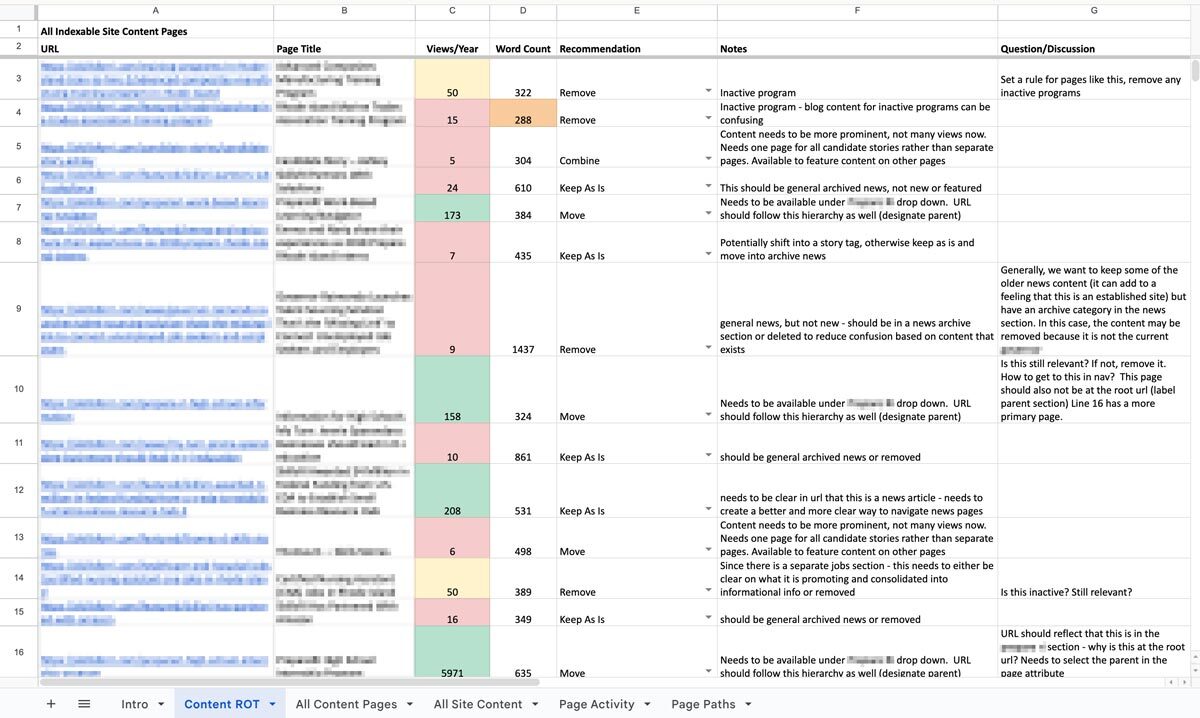
The big outcome is one of my personal favorites: a clean, annotated, actionable spreadsheet. Specifically, we’ll put together an audit of your content with links, page titles, notes on whether the content falls into any of the three ROT categories, and what to do about it: keep, modify, combine, or delete. Depending on the tools your content team uses or what you are willing to subscribe to, we might prepare dashboards and reports directly within an app that your team can use as an ongoing progress tracker. Wherever this list of to-do’s lives, we’ll help you prioritize it so you can start ticking off the most crucial items. Depending on what we decided in early scoping agreements, we can even help work through some high-impact issues, like bulk deleting content, suggesting rewrites, and fixing broken links.
We can also set up an ongoing content hygiene plan. While a dedicated content ROT analysis is a great way to identify and work through issues, an effective content plan should prevent ROT as much as possible and reduce the need for a large effort in the future. This might involve setting up policies, practices, and tools to guide future content management. We’ll help you find ways to see the bigger picture when updating or developing new content to make sure all pieces are accounted for. And when ROT falls through the cracks, you’ll have a plan to regularly review site content, setting ahead of time the when, what, and who.
One Piece in the Puzzle of Strong Content
As we continue to inspect the quality of your website and other digital properties, we can use this ROT analysis as a jumping off point. The initial audit may lead directly into a deeper content audit to evaluate URL paths, heading usage, performance metrics, reading level, and more. As we consider reworking, combining, and cutting entire pages, we may find the need to restructure your information architecture and taxonomy structures, in part or in whole, informed by research exercises like card sorts and tree tests. Depending on what we’ve found in the existing content and how it needs to change, we might suggest changes to your content model, adding, modifying, or removing content types and the relationships between them.
A content ROT analysis is a flexible and fruitful way to take a fresh look at your content ecosystem. If you need help getting started, let us know. We’d love to dig in with you!